To purchase this video please click “Add to Cart”.
Login to watch this video if you have a subscription. Learn more about subscriptions.Autocomplete predicts the next word. An AI agent can search a file, use a tool, keep a result, and choose its next step. This course explains the changes in the model and the surrounding software that connect those two systems.
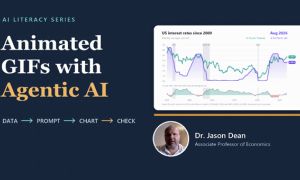
Dr. Jason Dean starts with the short word windows of n-gram models, then explains learned representations, attention, Transformers, pretraining, and post-training. Animated diagrams show what each change adds and where its limits remain. The course then moves outside the model: files and retrieval supply relevant material, tools perform permitted actions, and a control loop uses results to choose later steps.
You will learn to distinguish what a model learned during training from what an application supplies for a particular request. You will also compare a single response, a fixed workflow, and an agent loop, then examine the state, permissions, approvals, validation, and stopping rules around repeated actions. No programming background is required.
By the end of the course, learners should be able to:
- explain how an n-gram model predicts a next word and why longer contexts create sparse evidence;
- distinguish training from inference and trained parameters from current context;
- describe the roles of embeddings, attention, Transformers, softmax, and temperature;
- separate a model from the application, files, retrieval systems, and tools around it;
- distinguish additional reasoning within one response from a workflow or agent loop;
- identify the state, permissions, approvals, validation, and stopping rules needed around repeated model actions; and
- ask five concrete questions when evaluating an AI system: what was learned, what is in context, which sources and tools are connected, what actions are permitted, and what makes the process continue or stop.
Dr. Jason Dean is an economist and Associate Professor in the School of Management, Economics, and Mathematics at King’s University College, as well as an instructor at Wilfrid Laurier University’s Lazaridis School of Business and Economics. He received a BBA from Wilfrid Laurier University, an MA in Economics from the University of Guelph and a PhD in Economics from McGill University. He teaches courses in macroeconomics and microeconomics, applied econometrics and labour economics. His research examines labour-market issues, housing, health, immigration and employment, and his work has appeared in peer-reviewed academic journals.


*see individual programs and jurisidictional allowances for accredited hours/requirements for Canadian law societies.
See how easy it is to complete your legal and finance Continuing Professional Development online.
Call us at 1-888-295-4868 or send us an email.


*see individual programs and jurisidictional allowances for accredited hours/requirements for Canadian law societies.